


















Henry Lea
Described as "an engineer of remarkable talent whose expertise ranged widely over the civil, mechanical and electrical disciplines," Lea (1839-1912) was a pioneer in the field of electric lighting and artificial ventilation. His most notable project was the scheme at the Royal Victoria Hospital, Belfast in 1903. He is widely thought to have been the first to claim the title of consulting engineer when he opened his Birmingham office in 1862 and distributed a letter that stated: "Henry Lea begs leave respectfully to announce that by the advice of many gentlemen well acquainted with his qualifications and experience, he has commenced practice as a consulting mechanical engineer."
Dr David Boswell Reid
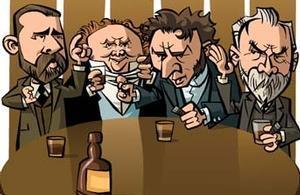
Reid (1805-1863) was a Scottish doctor, chemist and ventilating engineer. The project with which he is most famously associated is St George's Hall, Liverpool. Reid designed the heating and ventilating system for the hall and much of it is still in place today. In his book The Comfort Makers, Brian Roberts describes Reid's approach to his work: "Advocated the addition of various chemicals to ventilating air, some to aid recovery in hospital wards, others to counteract the deleterious effects of vitiated air. Reid demonstrated his theories at a dinner in Edinburgh, claiming that, as a result of his methods of ventilation, the diners consumed two or three times as much alcohol as usual, without ill effect."
Wilson Weatherley Phipson
Phipson (1838-1891) was a civil engineer who specialised in heating and ventilation. Phipson began work as a consulting engineer around the same time as Henry Lea. He also sometimes worked in a contracting capacity. Described by Roberts as "both a pioneer and an innovator who employed mechanical and natural ventilation systems, often together, with varying degrees of success", Phipson worked on a number of high profile projects, including the Strand Music Hall (1864), Glasgow University (from 1864), the Natural History Museum (1873), the Royal Albert Hall (1871) and Alexandra Palace (1874). Roberts says Phipson "killed himself through overworking and excessive travelling (over 3000 miles in a fortnight)."
David Mein Nesbit
Nesbit (1855-1929) was the first president of the HVCA and third president of the IHVE. Roberts says: "Nesbit addressed the Master Steam and Hot Water Fitters National Association in New York in 1894, but the discourtesy shown at his reading of his technical paper so incensed Hugh Barron (an American contractor), that with others he founded the American Society of Heating and Ventilating Engineers." Nesbit was one of ASHVE's first international members and this means that he can be credited with the honour of having been involved in the founding of three great "comfort" organisations. After the event in 1894, Roberts recalls what Barron had to say: "There was one thing conclusively shown by this convention, and that was that engineers are indeed in a decided minority; the majority are more anxious about getting work and money than about the mere art of heating."
Thomas Tredgold
Tredgold (1788-1829) is credited with defining the profession of civil engineering as "being the art of directing the great sources of power in nature for the use and convenience of man." Starting out as a carpenter, he later worked in the London office of architect William Atkinson. He was published many times over: "Many technical papers on elasticity, strength of materials, flow of fluids, and heat were published, as well as Principles of warming and ventilating public buildings, dwelling houses, manufactories, hospitals, hot houses, conservatories, etc. (1824) which transformed an empirical art into a numerate technology and brought together engineering, physiology, and comfort." Tredgold was elected an honorary member of the Institution of Civil Engineers in 1821.
Edmund William Mayner
Mayner (1862-1944) falls very much into the category of unsung heroes. He could be regarded as the father of the Institute of Heating and Ventilating Engineers. Roberts says: "Mayner was largely responsible for setting up the IHVE. He was probably the first member and the first practising engineer to join. He never occupied the Presidential chair, preferring to hold the post of chairman of an executive committee." Roberts also records that Mayner's efforts in the setting up of the institution were never formally recognised during his lifetime.
Jacob Perkins
Perkins (1766-1849) is credited with securing the first patent on refrigeration. He was born in Massachussets and moved to England 1819. He also secured a number of patents relating to boilers and steam engines. His refrigeration patent was for a closed-cycle vapor-compression machine. Roberts says the machine was patented as "Improvement in the apparatus and means for producing ice, and in cooling fluids."
Andrew Ure
Ure (1778-1857) is the man who coined the word thermostat. He was born in Scotland and was doctor of medicine and professor of chemistry and natural philosophy. In 1830 he was appointed analytical chemist to the board of customs in London and in the same year was granted a patent for "An apparatus for regulating temperature in vaporisation, distillation and other processes."
Arthur H Barker
Barker (1870-1954) is now regarded as the father of radiant heating. His classic textbook Barker on heating was published in 1912 and he was appointed as the first lecturer on heating and ventilation at London University. In 1903 he invented a steam accelerator called the Cable System, for increasing flow in hot water heating systems. He became President of the IHVE in 1922 and was twice awarded the silver medal (1906 and 1909). The CIBSE Barker silver medal award is named in his memory.
George Haden
The son of George Haden Sr, Haden (1788-1856) formed G&J Haden with his brother James in Trowbridge in 1816. The company was formed as an agent of Boulton & Watt to erect steam engines for West Country cloth mills. Roberts says: "George was regarded as somewhat pious but the more dynamic of the two brothers and probably the better business manager. A natural extension of their work was the installation of the associated steam piping systems and this may have awakened the brothers' interest in heating."
Roberts says that the warm air ventilating stove,developed and patented by George, provided the real platform for their move into heating. George became involved in supplying boiler plant and heating for what Roberts describes as "the huge growth in institutional buildings, particularly lunatic asylums and prisons."
Do you agree with the top ten, or are there any glaring omissions? If you think we have missed anyone out you think deserved to figure in the list, our Letters page is the place for you to state their case for inclusion.
Source
Building Sustainable Design

No comments yet